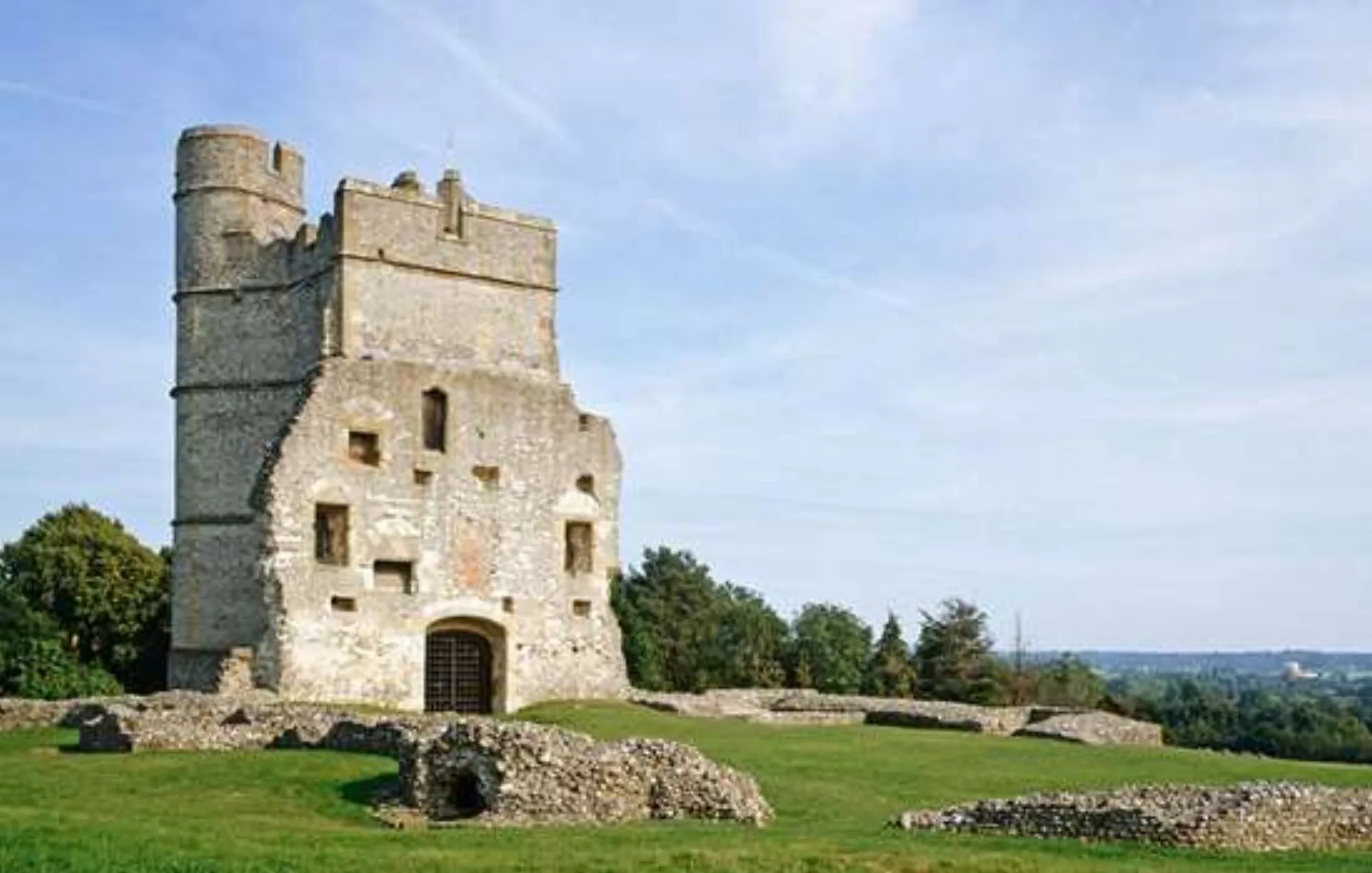
Deddington Castle
A wide, quiet bowl of grass and ancient earthworks on the edge of one of Oxfordshire's loveliest villages.
A wide, quiet bowl of grass and ancient earthworks on the edge of one of Oxfordshire's loveliest villages.
We should be honest about one thing before you set off: there is no castle at Deddington Castle, not in the turrets-and-drawbridge sense. What survives is the earth itself, a vast motte-and-bailey shaped by hand after the Norman Conquest, with grassy ramparts rising as high as fifteen metres and broad ditches sweeping around them. The stone keep and walls were dismantled and carted off centuries ago. But we think that absence is exactly the point. You get the scale and the silence of a great fortress without the crowds, the ticket queue or the gift shop, and on the right morning it is one of the most quietly atmospheric places we take people near the cottage.
It is an English Heritage site, free to enter, with no barrier and no opening hours to plan around. The entrance sits on Castle Street near the junction with Hopcraft Lane, marked by two stone pillars, and from there you simply walk in. We usually pair it with a wander through the village and a coffee or a pint, which turns a fifteen-minute stop into a genuinely lovely low-key afternoon. Wear something on your feet that copes with grass and slope, because the ground is uneven and gets muddy after rain, and there are no paths or facilities inside the earthworks. That is a feature rather than a fault: once you are up on the ramparts the road and the houses fall away, and it is just birdsong and the shape of the land.
The castle was raised in the years after 1066 by Odo, Bishop of Bayeux, half-brother of William the Conqueror and one of the wealthiest men in the country. It was strengthened with some stone defences in the twelfth century, then slid into disrepair from the thirteenth as its owners lost interest and the buildings were pulled down and sold off. Its most dramatic moment came in 1312, when Piers Gaveston, the deeply unpopular favourite of Edward II, is thought to have taken refuge here before being seized by his enemies and led away to his execution. Today English Heritage looks after the inner bailey, the parish council the western part, and the eastern bailey is still farmed, which is why the earthworks flow so naturally into the fields around them.
The castle takes half an hour at most, so we always fold it into a wider stroll around Deddington, one of the loveliest of the local villages, with its honey-coloured square, good pubs and an excellent farmers' market on the fourth Saturday of the month. For picnic supplies, Eagles Fine Foods is the deli to know a few steps from the green. If you would rather someone else did the cooking, The George Inn at nearby Barford St Michael is a proper thatched village local worth the short hop. For more ideas within easy reach, our guide to things to do in the area gathers the walks, houses and days out we point guests towards.
“Don't expect a castle, expect a hill fort with a thousand years of history in it. Combine it with a wander round Deddington and a pint, and it's a perfect low-key afternoon, about fifteen minutes from the door.”
All of this on the doorstep, and your own thatched cottage to come home to. Sleeps seven, less than a mile from Soho Farmhouse.