Oxford
The historic city of dreaming spires, with its world-famous university colleges, museums, riverside walks and renowned restaurants and pubs.
The historic city of dreaming spires, with its world-famous university colleges, museums, riverside walks and renowned restaurants and pubs.
Oxford sits about 35 minutes south of the cottage, and it never quite loses its capacity to stop us in our tracks. Matthew Arnold called it the city of dreaming spires, and the phrase still fits: a skyline of honey-coloured towers above streets that have been home to the oldest university in the English-speaking world for the better part of a thousand years. We treat it as a proper day out, as there is far more here than an afternoon allows.
What we love most is how compact it all is. The great set pieces sit within a ten-minute walk of one another, so a single loop can take in a college quad, a museum, a medieval market and a riverside punt. Go on a weekday if you can, when the tour groups thin out and it feels like a working city that happens to be spectacularly beautiful.
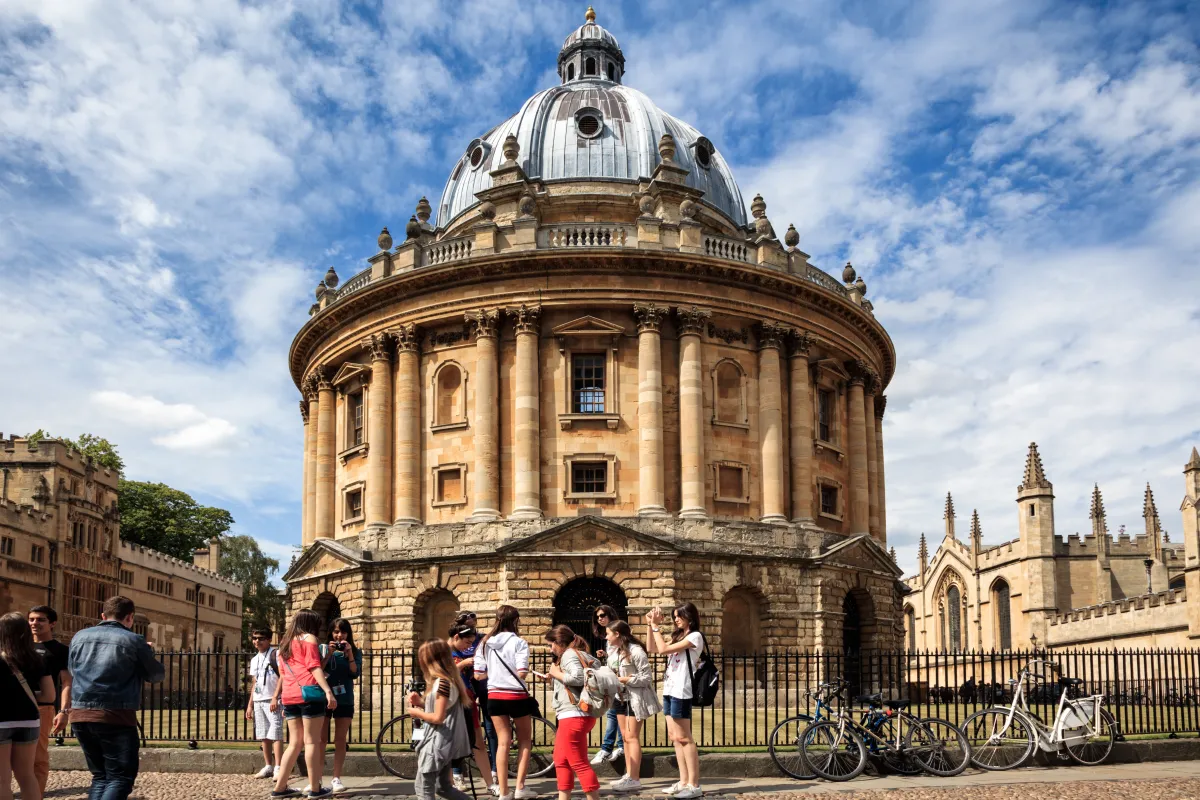
We usually start in Radcliffe Square, which is about as good an introduction to the city as exists. The Bodleian Library wraps around one side, its great domed reading room, the Radcliffe Camera, standing alone in the middle of the cobbles, and the whole square is ringed by the spires and railings of the surrounding colleges. From here it is a short stroll to almost everything else worth seeing.
The colleges are the heart of it. Christ Church is the grandest, with a hall that helped inspire the one in the Harry Potter films and a cathedral tucked inside the college walls; Magdalen has its own deer park and bell tower beside the river; and New College hides some of the finest medieval cloisters in the city behind an unassuming lane. Most open to visitors for a small charge, though hours vary with term and exams, so it is worth checking first. For a quieter, cheaper way in, time an evening visit for Christ Church's Choral Evensong, free to attend and, when the choristers are singing in term, genuinely magical.
Then there are the museums, and several of the best are free. The Ashmolean on Beaumont Street is the oldest public museum in Britain and the world's first university museum, rewarding a couple of unhurried hours across everything from Egyptian mummies to Pre-Raphaelite paintings. With children we head instead for the Oxford University Museum of Natural History, with its dinosaur skeletons under a soaring glass roof, and the Pitt Rivers Museum that opens off the back of it, a dense cabinet of curiosities crammed with masks and totems. Smaller and quieter, the Bate Collection gathers centuries of musical instruments in the university's music faculty, and is free to visit too. To hear music rather than look at it, the Holywell Music Room a few streets away is reckoned the oldest purpose-built concert hall in Europe, opened in 1748 and still putting on intimate chamber concerts, including a much-loved series of Sunday-morning Coffee Concerts.
No first visit is really complete without punting. You hire a flat-bottomed boat from Magdalen Bridge and push yourself along the river with a long pole, which is far harder than the students make it look and all the more fun for it. On a warm afternoon, drifting under the willows with a picnic is about the most Oxford thing you can do. When your arms give out, the covered market is the place to recover: a warren of independent stalls trading since the eighteenth century, from butchers and cheesemongers to a famous cookie counter and cafés for a well-earned sit down. The walk between it all is half the pleasure, so it is worth simply looking up at the gargoyles, sundials and spires as you go.
A few of our favouritesFor a pint, nothing beats the Turf Tavern, tucked down a medieval alley off Holywell Street and almost impossible to find the first time. The Bear Inn is one of the oldest pubs in the city, low-beamed and lined with clipped neckties. For something completely different, the Coconut Tree serves Sri Lankan street food and cocktails a short walk away. For a proper sit-down meal, Quod on the High Street is a lively all-day brasserie set in a former bank, and a reliable place to end a day on your feet.
Oxford is about 35 minutes from the cottage by car, dropping down the A44 through Woodstock or the A40 from Burford. Driving right into the centre is not worth the stress: the medieval street plan, the one-way system and the shortage of parking all conspire against you. Instead we use a park-and-ride, leaving the car cheaply and taking a frequent bus into the centre.
Coming from our direction, Pear Tree and Oxford Parkway (the site formerly known as Water Eaton) are the natural choices, both on the northern edge of the city and signposted off the A44 and A40 as you approach from the Cotswolds. If you would rather not drive at all, there are direct trains to Oxford from Kingham and Charlbury, both a short hop from the cottage. If you're planning a visit, our holiday cottage near Oxford makes a quiet countryside base for the city.
All of this on the doorstep, and your own thatched cottage to come home to. Sleeps seven, less than a mile from Soho Farmhouse.