Burford
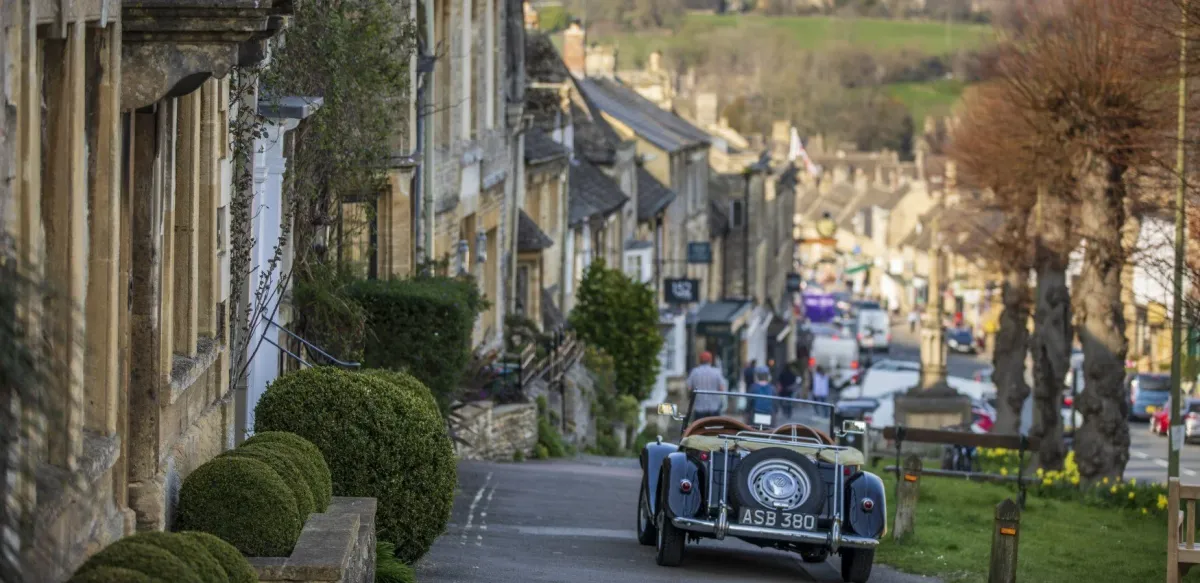
The gateway to the Cotswolds: a medieval wool town whose steep golden-stone High Street tumbles down to the River Windrush.
The gateway to the Cotswolds: a medieval wool town whose steep golden-stone High Street tumbles down to the River Windrush.
There are few introductions to the Cotswolds more handsome than Burford's High Street. It drops steeply between rows of honey-coloured buildings, each one slightly different in age and proportion, until it reaches the old stone bridge over the River Windrush. We tend to park at the top and simply walk down, because the whole town reveals itself that way: the shopfronts, the coaching inns, the wynds and passages running off to either side, and finally the church and the river at the bottom of the hill. About thirty to thirty-five minutes from Well Cottage through the lanes, it is one of the easiest half-days out we point guests towards, and one they almost always come back raving about.
The prosperity behind all that stone came from wool. Between the fourteenth and seventeenth centuries Burford was one of the more important wool towns in the country, and the money of that era is still legible in every gabled facade, carved lintel and mullioned window. Halfway down the hill the Tolsey, a former market and toll house raised on stone pillars above the pavement, now holds a small local-history museum. It is the kind of place we always suggest a wander through if the weather turns, and the volunteers behind the desk usually know more about the town than any guidebook could tell you.
What keeps us coming back is that the High Street is still a working street rather than a museum piece. Antique dealers sit alongside independent delis, a good bookshop, galleries, homeware shops and the sort of tea rooms that invite you to lose an afternoon. Burford has a long reputation for antiques, and it is deserved: this is a place to browse furniture, silver and ceramics in rooms that take some unhurried looking to properly see. Our favourite is Manfred Schotten Antiques at 109 High Street, which specialises in sporting and library pieces made to be used hard and to age beautifully. Even if you buy nothing, an hour drifting between the shops is time well spent.
At the foot of the hill the Church of St John the Baptist is, for us, the quiet highlight of any visit. It is a grand medieval wool church, Grade I listed, with a merchants' guild chapel, a fine spire and a wealth of monuments and brasses that reward a slow wander through the nave and side chapels. Its most surprising story is a Civil War one: in 1649 several hundred mutinous soldiers of the New Model Army, the Levellers, were held prisoner here, and some left carvings still visible on the font. Step outside and the River Windrush is right there, slipping under the old stone bridge with meadows on either bank. On a fine day it is one of the loveliest spots in the whole of the Cotswolds for an idle half-hour or a picnic before the drive home.
Burford pairs naturally with a second stop. Just south of the town, Cotswold Wildlife Park and Gardens is a serious zoological collection set in the grounds of a Victorian manor, and a reliable favourite with children and adults alike. For lunch or a pint we usually steer people to The Lamb, a handsome Cotswold inn tucked just off the High Street, while the villages along the Windrush a few minutes east put you within reach of The Swan Inn at Swinbrook and The Three Horseshoes at Asthall. If you fancy something a little more polished on the way back, The Farmer's Dog sits comfortably within reach. Burford is worth revisiting across the seasons, too: the High Street in early autumn, when the golden stone deepens and the crowds thin, is a different and better place than the busy heart of summer.
All of this on the doorstep, and your own thatched cottage to come home to. Sleeps seven, less than a mile from Soho Farmhouse.