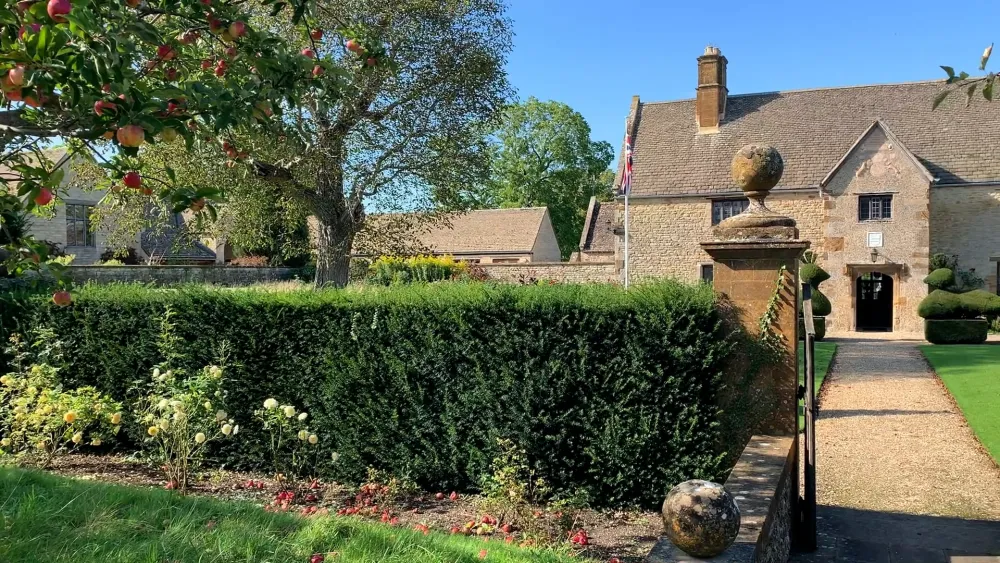
Sulgrave Manor
A handsome house built in 1539 by an ancestor of George Washington, telling the family's story north-east of Banbury.
A handsome house built in 1539 by an ancestor of George Washington, telling the family's story north-east of Banbury.
We think of Sulgrave as a slow-morning sort of outing. It sits about half an hour from the cottage, out past Deddington and Aynho into the folded lanes of south Northamptonshire, and it rewards the kind of visit where you are in no particular hurry. The manor keeps limited hours, so we always look at what is on before we set off, but when the timing lines up it makes a lovely half-day: an hour or two in the house and gardens, then lunch in one of the villages on the way home. It is a modest drive for a place that quietly connects a Cotswold hillside to the founding of the United States.
Lawrence Washington, a wool merchant who had done rather well for himself, bought the priory land at Sulgrave after the Dissolution of the Monasteries and built his family a house from the stone. The Washington family coat of arms, with its stars and stripes, is carved above the doorway. (Yes, those stars and stripes. The resemblance to a certain flag is no coincidence.) The manor passed through several families over the centuries, each leaving their own mark: Tudor stonework, Jacobean oak panelling, a kitchen garden that still grows the herbs a seventeenth-century household would have relied on. In 1914, with the centenary of a hundred years of Anglo-American peace approaching, a group of subscribers on both sides of the Atlantic bought the house and restored it as a symbol of the friendship between the two nations. His great-great-great-grandson, the young man who would grow up to become George Washington, never set foot here, but the family line that runs through these rooms is the one that eventually crossed the ocean.
What makes Sulgrave so appealing is its scale. This is not a grand stately home with roped-off corridors and audioguides. It is a comfortable manor house where you can peer into cupboards, run your hand along oak beams, and chat to the knowledgeable volunteers who seem to know every family scandal going back five centuries. Entry to the house is by timed slot, and there is no fuss to it: you arrive, you join the next tour, and someone who clearly loves the place walks you through it. We find children tend to enjoy it more than you might expect. There is something about the low doorways and uneven flagstones that appeals to the imagination, and nobody minds a bit of running about in the garden afterwards.
This is the one thing worth getting right. Sulgrave keeps limited, seasonal hours rather than opening daily, and special events can move things around, so we always check the current open days and entry times on the manor's own website before committing to the drive. Entry to the house is by timed ticket, admission is charged, and it is worth arriving with a slot in mind rather than turning up at closing time. We have given honest guidance here, but opening arrangements do change from season to season, so please treat the official site as the last word.
Because Sulgrave sits just the other side of Banbury from us, it pairs naturally with other things on that side of the county. Broughton Castle, one of the loveliest moated houses in England, is a short hop away and keeps similarly limited hours, so the two can sometimes be strung together on the same afternoon. If the day is more about a wander than a house tour, Banbury is on the way with its market, canal and famous cross. And if you have petrol-heads in the party, Silverstone is close enough to fold into the same corner of the trip.
“It's one of those places where a small house tells a very large story. You walk in thinking Tudor manor, you walk out thinking about the Atlantic, independence, and how history turns on a wool merchant's ambition.”
All of this on the doorstep, and your own thatched cottage to come home to. Sleeps seven, less than a mile from Soho Farmhouse.