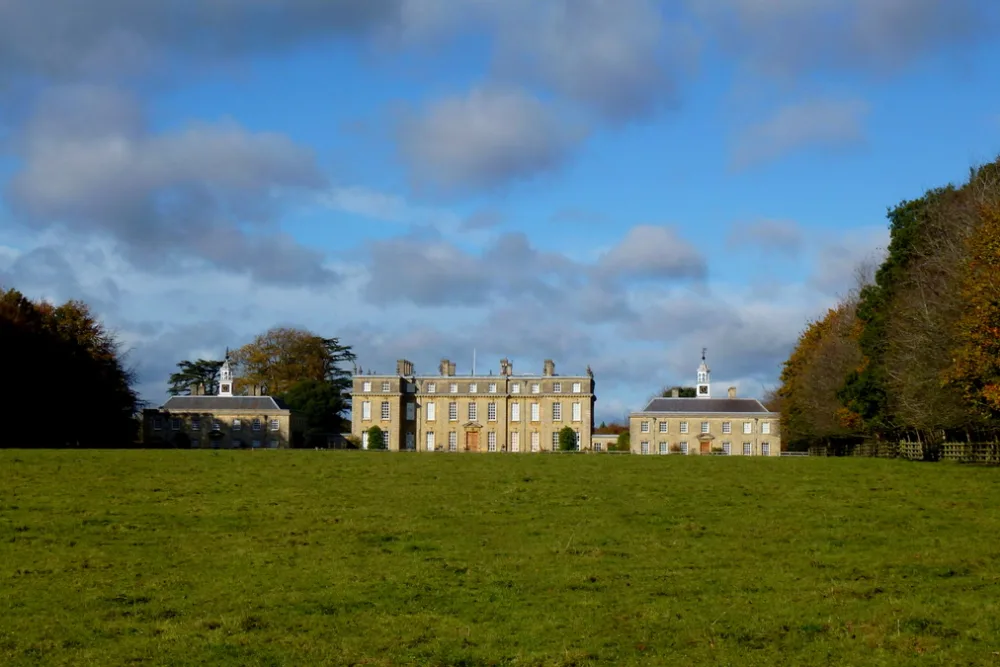
Ditchley Park
A great Palladian house hidden in the woods near Charlbury, where Churchill spent his moonlit wartime weekends and where the world still comes to talk.
A great Palladian house hidden in the woods near Charlbury, where Churchill spent his moonlit wartime weekends and where the world still comes to talk.
Ditchley is the sort of place you can live near for years without quite realising it is there. Set back in its own wooded park off the lane between Enstone and Charlbury, only a few miles from the cottage, it is one of the finest Palladian houses in England and yet almost nobody sees it. James Gibbs, the architect of St Martin-in-the-Fields, drew up the design in 1722 for George Lee, the 2nd Earl of Lichfield; William Kent and Henry Flitcroft fitted out the interiors; and the honey-coloured house that resulted, flanked by two elegant pavilions, has sat here in dignified privacy ever since. It is Grade I listed, and it has never been a house you simply turn up to visit. For more of the county's wartime story, the codebreakers' Bletchley Park is about an hour on.
Its most famous chapter belongs to the war. In the autumn of 1940 the intelligence services worried that Chequers, the prime minister's official retreat, was dangerously easy to find from the air on a bright night, its long drive pointing towards it like an arrow. So on moonlit weekends Winston Churchill was quietly moved instead to Ditchley, then the home of the Anglo-American MP Ronald Tree and his wife Nancy Lancaster. He first arrived on 9 November 1940, and over the months that followed he ran a good deal of the war from its rooms, working the telephones late into the night, screening films after dinner, and hammering out parts of the Lend-Lease agreement with Roosevelt's envoy Harry Hopkins across the table. Nancy Lancaster, one of the great interior decorators of the century, had by then made the inside of the house as celebrated as the out, and it is her warm, faded, country-house style that still shapes how English rooms are dressed today.
Since 1958 the house has belonged to the Ditchley Foundation, set up by Sir David Wills to bring people from Britain, Europe and America together for frank, off-the-record conversation. That is still exactly what happens here: through most of the year the house is a working conference centre, quietly hosting politicians, diplomats, thinkers and rising talent for weekends of strategic talk on democracy, technology and the shape of the world. It gives the place a curious double life, a grand eighteenth-century house that is also, in its way, one of the busiest rooms in international affairs, and it is the reason Ditchley is not open in the ordinary way that a National Trust house is.
This is the honest part: Ditchley is a private foundation, not a day-out attraction, so you cannot simply arrive at the gates. What it does offer, from time to time, are pre-booked guided tours of the mansion and its state rooms, and it occasionally opens for national schemes such as Heritage Open Days, when a limited number of visitors can see inside for free. Those slots are few and go quickly. If stepping inside matters to you, the thing to do is keep an eye on the Foundation's own website and book the moment a public tour is announced. Even from the outside, the drive up through the estate and the view of the house across its park are a quiet pleasure, and knowing the story behind those windows changes how the whole valley feels. Always check the current arrangements on the Ditchley Foundation website before making any plans.
Ditchley sits in lovely walking country between Blenheim Palace and the Evenlode valley, so it slots easily into a wider day. Charlbury, with its station and good pubs, is a couple of minutes on; Enstone and the Neat Marsh farm shops are closer still. If it is grand houses you are after and Ditchley's doors happen to be shut, Blenheim is always open and only up the road, while Rousham offers William Kent's own garden a short drive the other way. For the fuller picture, our guide to things to do in the area runs from ancient stones to great gardens and everything between.
“We love that a house this important is hiding in our own back lanes. You cannot just wander in, but when Ditchley does open its doors for a tour, take it. Standing in the room where Churchill watched the war films is something you do not forget.”
All of this on the doorstep, and your own thatched cottage to come home to. Sleeps seven, less than a mile from Soho Farmhouse.