Woodstock
A graceful Georgian market town of honey-stone streets that grew up at the gates of Blenheim Palace.
A graceful Georgian market town of honey-stone streets that grew up at the gates of Blenheim Palace.
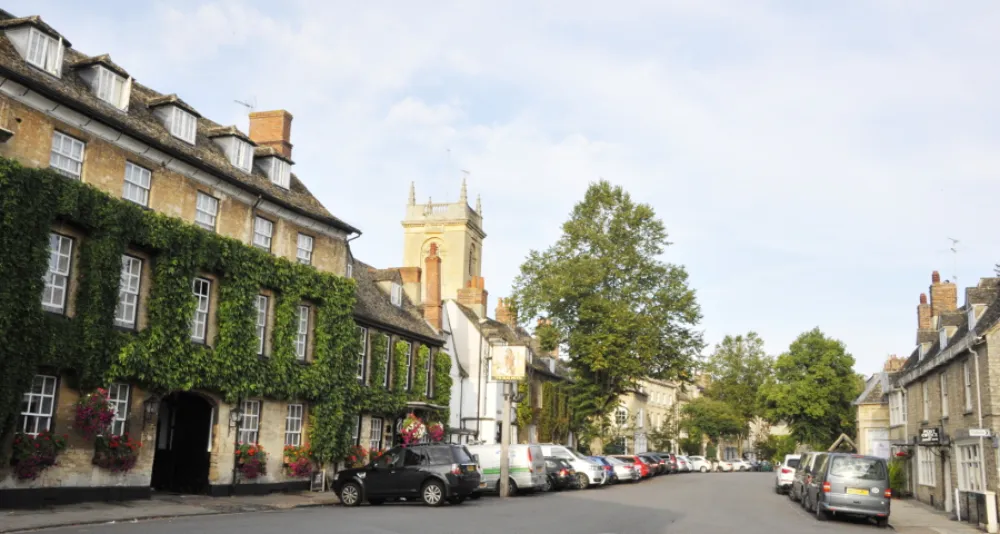
Woodstock has the air of a town that knows its own worth and feels no need to advertise it. The streets are lined with warm honey stone, the proportions are Georgian and generous, and the whole place carries itself with a quiet elegance. Henry II granted the town its market charter in 1179, and for centuries English kings kept a hunting lodge and deer park on the ground where Blenheim Palace now stands. We tend to treat Woodstock as a natural pairing with Blenheim, but it rewards a visit entirely on its own terms, and at roughly twenty-five minutes by car it is one of the easier half-days to reach from the cottage.
The great draw sits right on the edge of town. Blenheim Palace, the vast baroque house designed by John Vanbrugh for the first Duke of Marlborough and later the birthplace of Sir Winston Churchill, is a UNESCO World Heritage Site with a Capability Brown park you can walk for hours. You can reach it on foot from the town, through the gates and out across the landscape towards the lake and the Grand Bridge, which is much the nicest way to arrive. We usually give the grounds a morning and the town an afternoon, and find the two balance each other well: one is monumental, the other intimate.
The town itself is made for unhurried browsing. Its medieval street pattern is still legible beneath the Georgian frontages, and Park Street and the High Street are lined with independent shops, galleries and antique dealers, including a fifteenth-century building that houses a dozen established antique traders under one roof. Behind the older shopfronts you often find something more venerable still, since many of the period façades were simply fitted to buildings that were already centuries old. There is enough here to fill a slow morning without ever feeling like hard work, and enough good places to eat and drink that lunch is never a problem. It is the kind of town that suits a wet afternoon as well as a bright one, which is not something you can say of everywhere in the Cotswolds.
The Oxfordshire Museum occupies Fletcher's House, a handsome eighteenth-century townhouse in the centre of Woodstock, and admission is free. Its galleries carry the county's story from the Jurassic through the Romans and Anglo-Saxons to the Victorians, and the garden behind is the part children remember: a Dinosaur Garden with Jurassic planting and a life-size Megalosaurus, the very dinosaur first described from Oxfordshire fossils. It is an easy, low-commitment stop, and a good option if the weather turns.
Woodstock has kept a tradition of hospitality going for centuries, so there is no shortage of choice. The Bear on Park Street began life as a thirteenth-century coaching inn and is a handsome spot for a proper lunch; smaller cafés off the main square are reliable for coffee and something good in the afternoon. For a pub meal a little further out, The Killingworth Castle at nearby Wootton is one of our regular recommendations. A day that takes in the palace grounds in the morning, a wander through the town after lunch and a quiet detour to Bladon on the way home makes for one of the more satisfying days this part of Oxfordshire offers. The drive back to Ledwell through the Enstone lanes is one of the nicer runs in the area, and worth taking slowly rather than pressing straight on to the A44.
All of this on the doorstep, and your own thatched cottage to come home to. Sleeps seven, less than a mile from Soho Farmhouse.