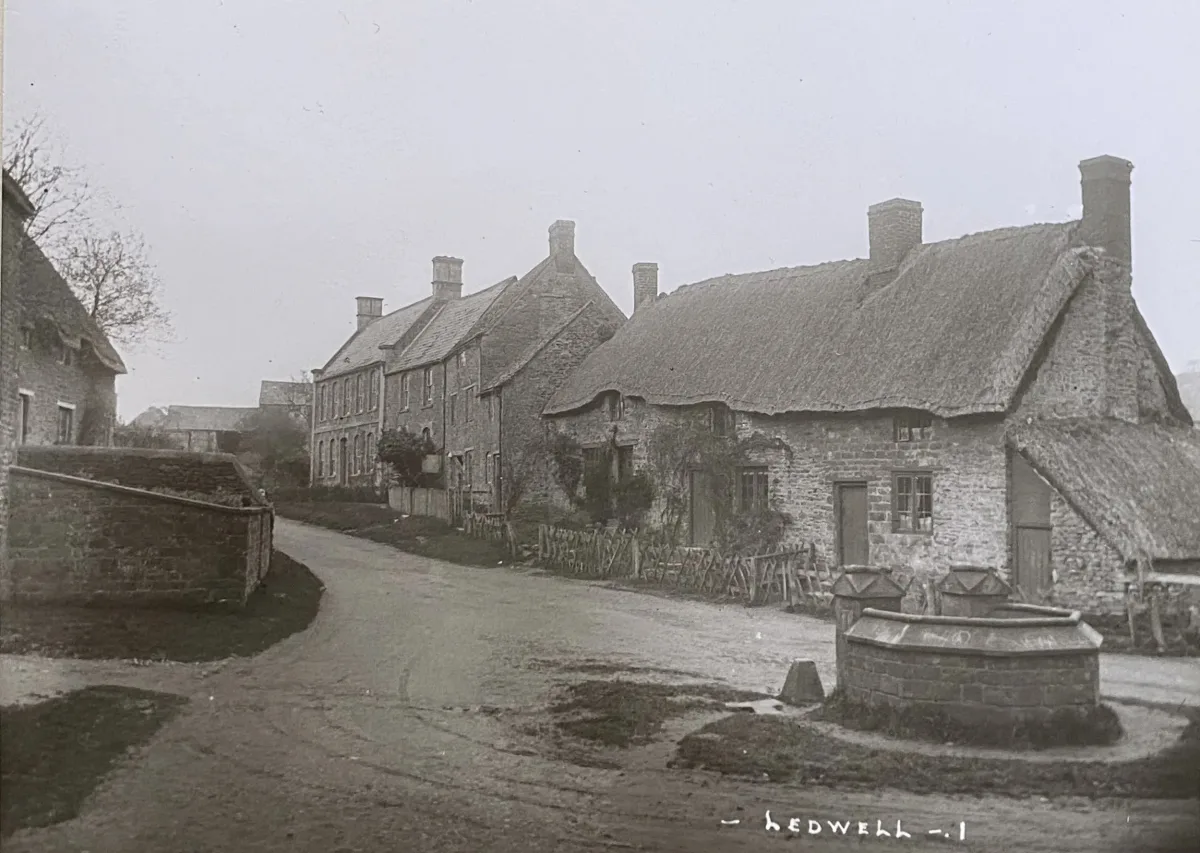
A History of Ledwell
Nine hundred years of records, one quiet spring, and the cottage that took its name from it.
Nine hundred years of records, one quiet spring, and the cottage that took its name from it.
Stand still in Ledwell and the first thing you notice is water. The hamlet takes its name from the Old English hlȳde welle — the "noisy spring" — and it is from that same spring, and the well it fed, that Well Cottage takes its own.
It is a tiny place, and an old one. Ledwell appears in the Domesday Book of 1086 as part of the royal manor of Bloxham and Adderbury. By 1279 the records count thirteen villeins and a cottar working eighteen yardlands of land, with five free tenants holding ten more — a working farming community already centuries old when the first stones of today's cottages were laid.
For a time Ledwell had grand ambitions. In 1666 Francis Smith, Lord Carrington, enlarged a house here called Ledwell Park, and was living in it by 1682. It changed hands to Richard Brideoak in 1685, and before 1717 passed to Henry Scott, 1st Earl of Deloraine, who rebuilt it at the considerable cost of more than £9,000. Grandeur did not last: by 1759 the house stood empty and dilapidated, and after Mary Heywood bought the estate in 1774 it was pulled down around 1800. Its outbuildings survive today as Upper Close Farm — the quiet afterlife of a country house that almost was. The hamlet also once had its own chapel, dedicated to St Mary Magdalene.
Well Cottage as it stands today was once three separate workmen's cottages, and the house carries that history in its layout. Two of them had already been joined together when my father bought the pair in 1979; the third he acquired in 2000. The renovation that followed the second purchase made the difference you feel as soon as you walk in: the cottage suddenly had room to breathe. The garden doubled in size. The library — the long, book-lined room that has become the heart of the place — was formed from what had been a separate dwelling. It is the kind of room that takes thirty years and three adjoining cottages to arrive at.
Its origins reach back to the 1700s, and it still wears its age openly: a thatched roof, oak beams worn smooth, deep walls of honey-coloured stone. Ledwell today is a conservation area, its listed cottages protected, its lanes much as they have always been.
We've restored the cottage carefully over the years — warm beds, a good kitchen, a fire in the grate — but the aim has only ever been to keep it the kind of place it has always been: a home in a small, peaceful village, where the spring still runs and very little else is in a hurry.
A thatched cottage with three centuries behind it, less than a mile from Soho Farmhouse.